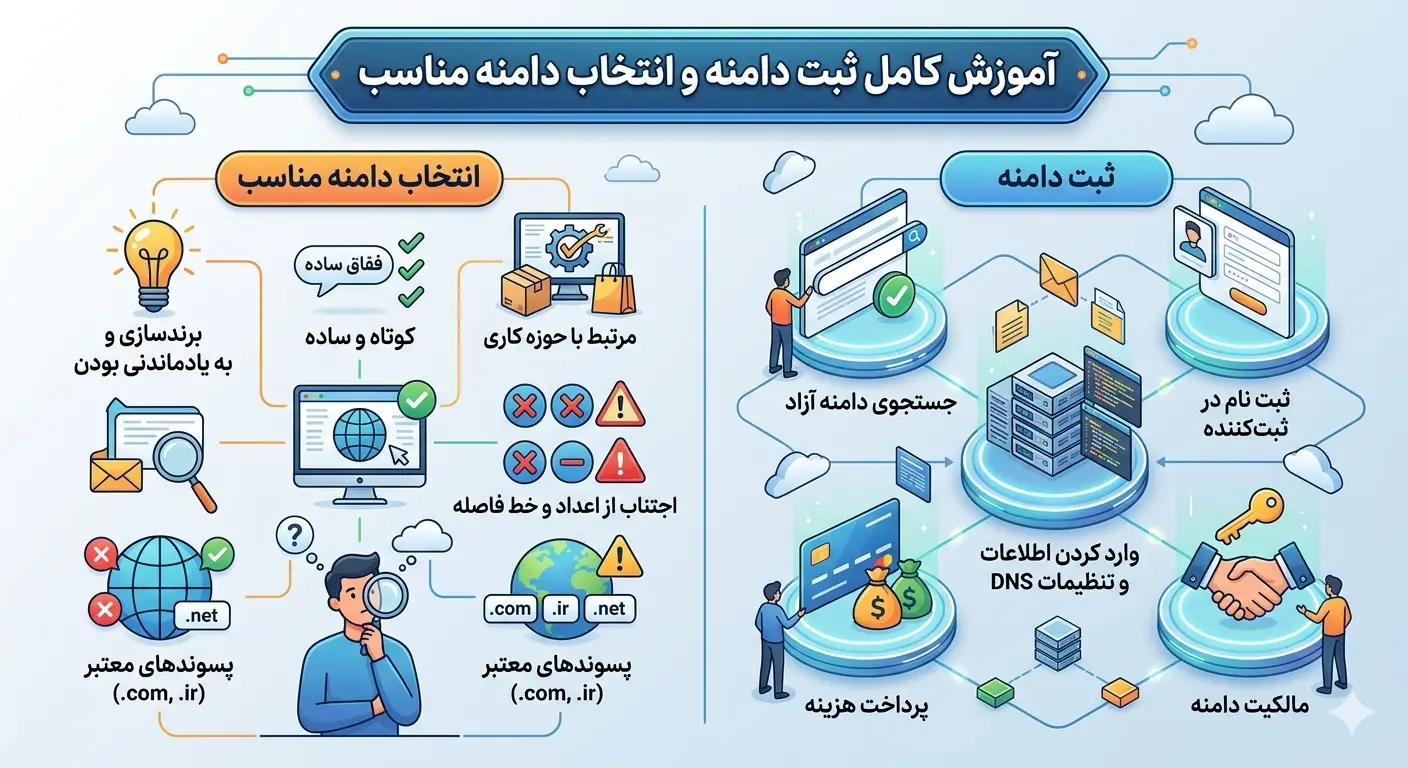
Domain registration is the first and most important step to building an online identity for any business, online store, or personal website. The domain is actually the same address that users type in the browser to reach your site; Like rapidoserver.com or rap2.ir. Choosing a suitable name and knowing the correct steps of domain registration can make a big difference in branding, SEO and audience trust. In this complete guide, we will review the domain registration process from zero to hundred, the criteria for choosing the right name, the types of extensions and security tips in simple language so that you can register your first domain safely.
What is domain and why is it important?
Domain is a unique and human-readable name that is used instead of the server's numerical address (IP). Computers work with numbers, but it is impossible for users to remember a string like 185.192.112.45. The domain name system or DNS is responsible for translating the understandable name of the domain to the IP address of the server so that the browser knows where to get the content of the site.
A good domain plays several key roles: first, it builds your brand identity and stays in the audience's mind; Second, it affects the ranking of the site in search engines; And third, it gains the user's trust. Users trust a site with a dedicated and professional domain more than a free subdomain. For this reason, choosing and registering a domain should not be taken lightly.
The structure of a domain name
Each domain consists of several parts. For example, in the shop.rapidoserver.com address, the com part is the extension or top-level domain (TLD), the rapidoserver part is the root name or second-level domain, and shop is a subdomain. When registering a domain, you choose and purchase the second level name with the extension of your choice and create subdomains later for free from the admin panel.
Criteria for choosing a suitable domain name
Before registering a domain, take some time to research different names. A good name should have the following characteristics to work in your favor in the long run:
- Short and memorable: Shorter names are easier to type and remember. Stay under 15 characters as much as possible.
- Simple in pronunciation and writing: Avoid names that have ambiguous spellings or are easily misspelled.
- Related to business: It is better if it conveys your name, mood or field of activity or is your brand name.
- No hyphens and extra numbers: Hyphens and numbers cause confusion when repeating addresses.
- Brandability: Choose a name that can be branded and is also available on social networks.
Tip: Before finalizing the name, read it out loud and have several people type it. If everyone writes correctly, your name is simple and reliable.
Check domain availability
Your preferred name may have already been registered by someone else. For this reason, you should first check its availability in the domain search system. If the desired name was taken with the original suffix, you can choose another suffix, change the name slightly or use compound words. In domain registration Rapido Server, you can search several extensions at the same time and see the price of each one.
Types of domain extensions (TLD) and their use
The domain extension is the last part of the address and its correct selection affects the position of your brand. Extensions are divided into several categories, the most important of which you can see in the table below:
| extension | type | suitable for |
|---|---|---|
| .com | International public | Commercial businesses and global brands |
| .ir | Iranian National | Iranian sites and domestic businesses |
| .net | general | Technology and network companies |
| .org | general | Non-profit organizations and institutions |
| .shop | thematic | Online stores |
| .co | Alternative public | Startups and emerging brands |
The .com extension remains the most popular and trusted extension in the world and is the best choice for businesses with an international audience. On the other hand, the extension .ir creates a more native feeling and trust for the Iranian audience, and the cost of registration and renewal is usually lower. Many businesses register both extensions together to protect their brand and cover both internal and external audiences.
Step-by-step steps of domain registration
The domain registration process is easier than you think. Just follow the steps below in order:
- Name selection: Prepare some candidate names according to the criteria we mentioned.
- Availability Search: Enter names into the domain search engine and see which ones are available.
- Extension selection and registration period: Choose the appropriate extension and specify the registration period (usually one to several years).
- Registration of owner information: Enter accurate and correct information of the domain owner; This information is important for verifying ownership.
- Payment and finalization: After payment, the domain is registered in your name and can be managed immediately in the panel.
Initial configuration after registration
After registering the domain, you need to set up the DNS records for your site to go up. The easiest thing to do is to point the domain's A record to your server's IP. An example of a basic record is as follows:
Type   Name    Value             TTL
A      @       185.192.112.45    3600
A      www     185.192.112.45    3600
If you want to host your site on a dedicated and powerful server, you can purchase a virtual server together with the domain to get both the address and the hosting platform from the same set and make their management easier.
Security tips and maintaining domain ownership
A domain is one of your most important digital assets, and losing it can seriously damage your business. To protect the domain, take several points seriously:
- Timely Renewal: If you do not renew the domain in time, it may be released and someone else can register it. Enabling auto-renewal reduces risk.
- Domain Lock: This feature prevents the unwanted or unauthorized transfer of the domain to another registrar.
- Protection of contact information: With the privacy service (WHOIS Privacy), the owner's personal information remains hidden from public view.
- Keeping the panel secure: A strong password and enabling two-step authentication is required for the domain admin account.
Warning: Never share your domain management panel information with unknown people. Many cases of domain theft occur through deception and social engineering.
Common mistakes when registering a domain
Many newbies make costly mistakes when registering a domain. The most common mistakes are choosing a name that is too long, using unconventional spelling, ignoring the brand rights and other people's business names, and registering a domain with incorrect owner information. Also, some users, without checking, register a domain that is very similar to a well-known brand and later face legal problems.
Another mistake is to focus only on the first year's price. Some extensions are cheap for the first year but have a high renewal fee. Before registering, be sure to check the renewal price for the following years so as not to be surprised in the future. To learn more about domain and hosting topics, you can visit Rapido Server Articles.
The difference between registrar, registry and sales representative
To better understand the domain registration process, it is good to familiarize yourself with the different roles in this chain. At the highest level, the registry is located; The organization responsible for managing a particular extension. For example, the management of the international extension .com is the responsibility of a global registry, and the management of the national extension .ir is the responsibility of the national domain registration center. Registries do not work directly with end users.
At the next level, there is the registrar; A company that has an official license to sell domains from the registry and you register the domain through it. Finally, a reseller is a company that resells the registrar's services and usually offers a simpler administration panel and local support. When you register a domain, your name is actually entered in the registry database through this chain and the official ownership is registered in your name.
Being aware of this structure will help you know who to turn to in case of problems and why some changes, such as domain transfer or release, take time; Because they must be approved and applied at the registry level.
Domain management after registration
Domain registration is not the end, but the beginning of its management. After registration, through the user panel, you have access to a set of tools with which you can fully control your domain. The most important of these tools are managing DNS records, setting up half-servers, activating domain locking and managing owner information.
Management of records and subdomains
In the management panel, you can set all kinds of DNS records, such as A, CNAME, MX and TXT, so that the site, email and other services work on your domain. You can also create multiple subdomains at no additional cost. For example, you might create a subdomain for your blog, store, or admin panel:
Type     Name    Value              TTL
CNAME    blog    rapidoserver.com   3600
CNAME    shop    rapidoserver.com   3600
A        panel   185.192.112.45     3600
Set up auto-renewal
One of the most important things to do after registration is to enable auto-renewal. With this, you won't have to worry about forgetting the expiration date and your domain will never be released accidentally. Many businesses have lost valuable domains because they forgot to renew; So this simple adjustment can prevent disaster.
Domain connection with branding and marketing
A domain is not just a technical address, but an important part of your business's visual identity and marketing. The domain name will appear on your business cards, advertisements, product packaging, and social media; Therefore, it should be chosen in such a way that it is both beautiful and easily transported. A good domain assures the customer that they are dealing with a serious and professional business.
The coordination of the domain name with your username in social networks is also important. If your domain name and social accounts are the same, your audience will find you more easily and your brand will look more cohesive. For this reason, before finalizing the domain name, check that the same name is also available on the social networks of your choice.
Finally, remember that it is very expensive to change a domain once the brand is established; Because you have to rebuild SEO, links and audience mentality. Therefore, it is worth spending enough time from the beginning to choose a correct and lasting name so that it will be with you for years without changing.
Domain registration and renewal fee
The cost of domain registration depends on the extension you choose and it varies significantly from one extension to another. National domains like .ir are usually the cheapest options, while international and thematic extensions like .com, .shop or .io cost more. In addition to the initial registration fee, you should also consider the annual renewal fee, which is more important than the first year price.
Some extensions offer the first year at a deep discount or even free, but renewals for subsequent years are much higher. For this reason, always check the long-term renewal price before signing up so that you don't face unexpected costs in the years to come. If you plan to keep the domain for several years, multi-year registration can both prevent price increases and reduce the risk of forgetting to renew.
In addition to the cost of the domain, if you plan to set up a website, you should also include the cost of hosting in your budget. Combining a suitable domain with a stable server is a worthwhile investment for a professional online presence that will help your business grow in the long run.
Frequently asked questions
How long does domain registration take?
Registration of international domains such as .com is usually done immediately after payment and the domain is active in your panel in minutes. .ir national domains are also registered in most cases at the same moment or in a few hours at most.
Can I change the domain extension later?
No, the suffix is part of the domain identity and cannot be changed. If you need a different extension, you must register a new domain with the same name and desired extension. Many users register several extensions of the same name together.
What happens if I don't renew the domain?
After expiration, the domain enters a grace period where you can renew it. If you do not take action within this period, the domain will be released and made available to others; Therefore, timely renewal is very important.
Do I need a host to register the domain?
Domain registration and hosting are two separate tasks. You can register just the domain, but to bring up the site you need a hosting space like a host or a virtual server to connect the domain to.