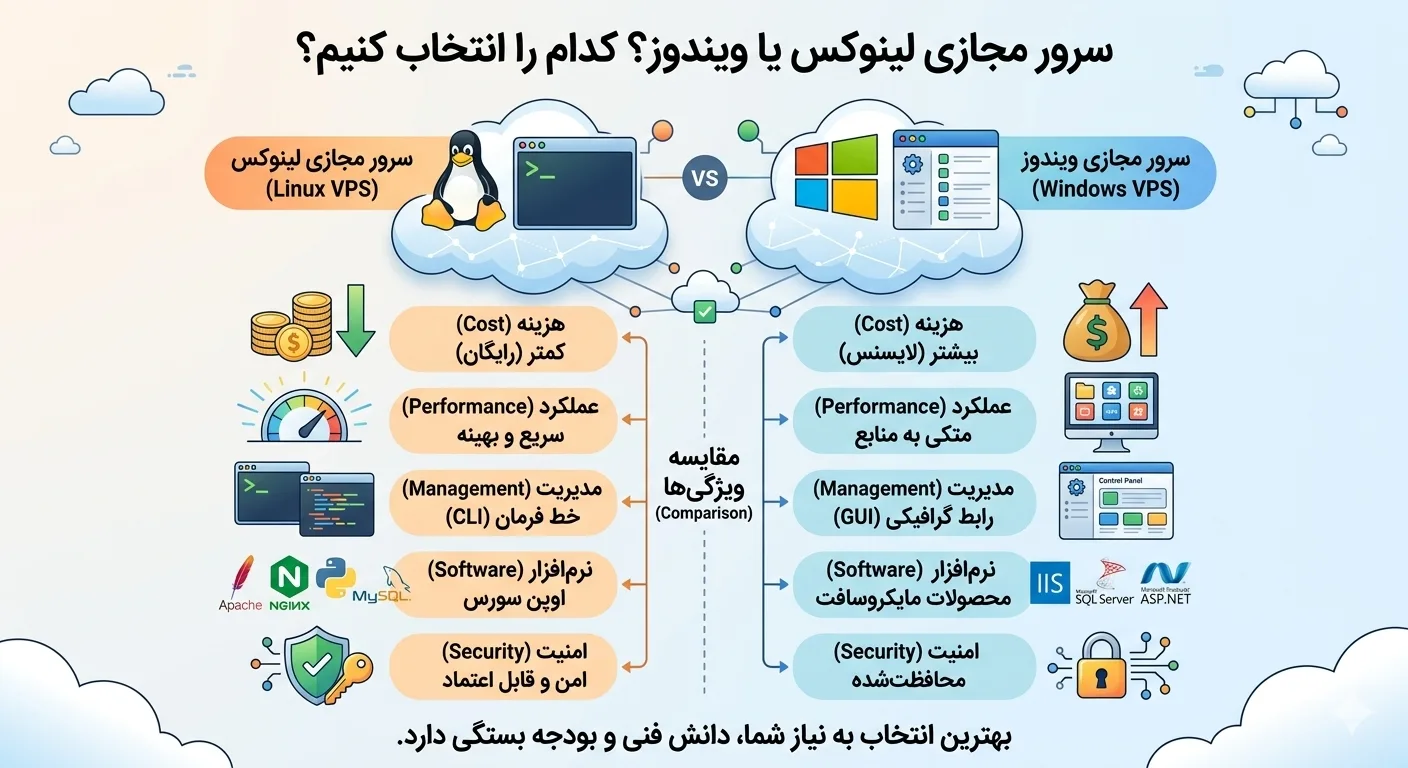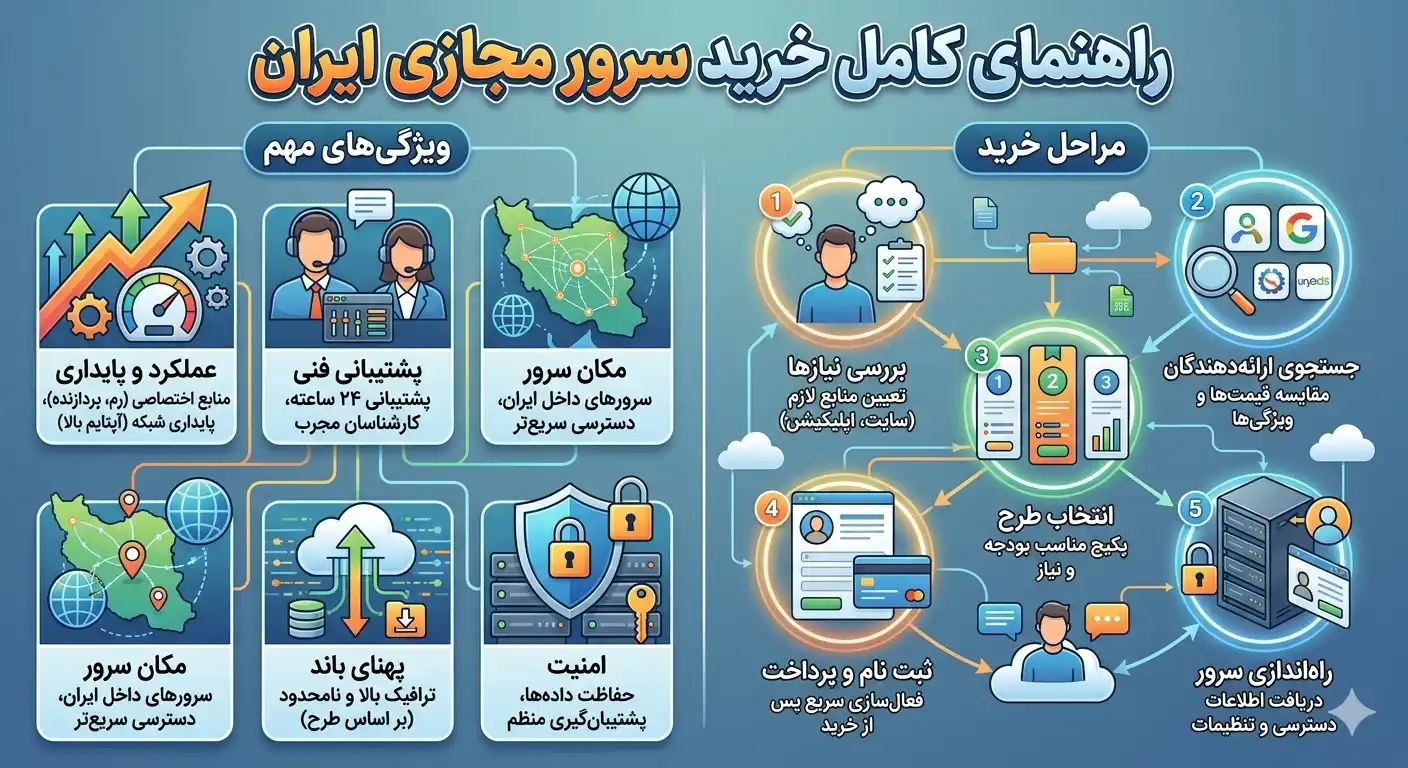
One of the most important decisions any website or online business owner has to make is choosing the right type of hosting. Understanding the difference between virtual and dedicated server as well as shared hosting is the key to making the right choice that will both optimize your budget and ensure the performance of your project. These three options are each designed for specific conditions, and the wrong choice can either lead to wasted money or slowness and instability of your service. In this comprehensive article, we will accurately and practically compare shared hosting, virtual server (VPS) and dedicated server so that you can make the best decision for your needs with complete knowledge.
Three types of hosting: an overview
Before examining the details and differences between virtual and dedicated servers, let's have a simple definition of all three types of hosting. These three options actually represent three different levels of power, control, and cost.
What is shared hosting?
In Shared Hosting, a physical server is shared among hundreds or even thousands of users. All resources such as processor, RAM and bandwidth are shared among these users. This model is the cheapest option and it is easy to manage, but you have no control over the server settings and the performance of your site is affected by the activity of other users.
What is a virtual server?
A virtual server (VPS) uses virtualization technology to divide a physical server into several independent virtual servers. Each VPS has its own dedicated and guaranteed resources and is completely isolated. You have root access and can configure the system as you like.
What is a dedicated server?
A dedicated server is a complete physical machine with all its resources only at your disposal. This option offers the highest level of power, control and security, but is also the most expensive choice and is usually used for large and heavy projects.
Difference between virtual and dedicated server in resources and performance
The most important axis in examining the difference between a virtual server and a dedicated server is how to allocate resources and performance. In a dedicated server, you are the sole owner of the entire hardware; So you have all the power of the processor, all the RAM and all the disk capacity without any competitors. This means maximum possible performance and complete stability even under very heavy workloads.
In a virtual server, resources are dedicated but limited to your share of the physical server. For example, you might have 4 CPU cores and 8 GB of RAM, while the main physical server has dozens of cores and hundreds of GB of RAM. However, since these resources are guaranteed and isolated, VPS performance is quite stable and reliable for most medium-sized projects.
In shared hosting, there is no guarantee of resources. If another user creates heavy traffic on the same server, your site may slow down. This phenomenon is known as "Noisy Neighbor" and is one of the main problems of shared hosting.
Complete comparison table of three types of hosting
To better understand the differences, the table below compares all key metrics at a glance:
| Criterion | Shared hosting | virtual server (VPS) | Dedicated server |
|---|---|---|---|
| resource allocation | shared | Exclusive and limited | Completely exclusive |
| Root access | does not have | has | has |
| control surface | very limited | up | complete |
| Monthly fee | very low | average | up |
| Security and isolation | down | up | very high |
| Upgradable | limited | Fast and flexible | Requires new hardware |
| The need for technical knowledge | low | average | a lot |
| High traffic performance | weak | good | great |
| suitable for | Small sites | Medium sites and apps | Heavy organizational projects |
The difference between virtual and dedicated servers in cost
Cost is one of the most determining factors in choosing hosting. In examining the difference between virtual and dedicated servers in terms of finances, a significant difference is observed. Shared hosting is the cheapest option and is available at a very low monthly cost. The virtual server is in the middle and its cost is several times that of the shared hosting but much less than the dedicated server.
A dedicated server is the most expensive option due to full hardware allocation and can cost several times the cost of a VPS. The bottom line is that paying for a dedicated server only makes sense when you really need its full power; Otherwise, a large part of the resources will remain unused and your money will be wasted.
Economy tip: Many businesses can get the same performance they expect from a dedicated server with a powerful virtual server at a fraction of the cost. First, measure your real need.
The difference in security and control
Security is another important axis in comparing these three options. In shared hosting, because the resources and environment are shared among users, the vulnerability of one site can indirectly affect other sites and has a lower level of security.
In a virtual server, there is complete isolation between users. Each VPS has its own independent environment and the activity or security issues of other users do not affect your server. Additionally, with root access, you can fully customize security settings, firewalls, and access policies.
A dedicated server offers the highest level of security because no other user is present on the hardware. This feature is very important for organizations that work with very sensitive data or have strict compliance requirements.
Which option is right for you?
Now that you are familiar with the difference between virtual and dedicated server as well as shared hosting, let's see what type of user each option is suitable for.
When should we choose a subscription?
- Personal websites, blogs and portfolios.
- Small business sites with low traffic.
- Projects with a very limited budget and no specific technical requirements.
When to choose a virtual server?
- Online stores and store sites are growing.
- Web applications and mobile backend with moderate traffic.
- Projects that require root access and custom configuration.
- Development, testing and staging environments.
When to choose a dedicated server?
- Big platforms with millions of monthly hits.
- Massive databases and heavy enterprise applications.
- Projects with very strict security and compliance requirements.
- Online games with a very high number of users.
For many businesses, a virtual server is the ideal balance point. If you are not sure which plan is right for you, you can check the various options on the Buy Virtual Server page and get advice from Rapido Server's technical team.
Growth path: from shared hosting to dedicated server
There is a common and logical pattern to the growth of online businesses. Many projects start with shared hosting, then migrate to a virtual server as traffic increases, and finally move to a dedicated server if needed. This gradual path helps you spend only as much as you need at each stage.
The great advantage of the virtual server in this direction is its ability to be gradually upgraded. You can increase your VPS resources step by step without expensive migration and continue with the same infrastructure for a long time. To read more about server selection and management, we suggest you visit Rapido Server Articles.
Differences in performance when traffic grows
One aspect that is very important when considering the difference between a virtual server and a dedicated server and shared hosting is the behavior of each option when traffic increases. Imagine you have launched a successful advertising campaign and suddenly the number of visitors to your site multiplies. The behavior of each type of hosting is completely different in this situation.
With shared hosting, sudden spikes in traffic often lead to severe slowdowns or even outages, as resources are limited and shared, and the provider usually imposes strict limits. In a virtual server, dedicated resources allow you to handle more traffic and quickly upgrade resources if needed to keep the site stable. In a dedicated server, due to the high hardware power, even very heavy workloads are easily managed.
Tip: If you expect your site traffic to fluctuate a lot, a virtual server provides the necessary flexibility to manage these fluctuations due to its ability to be quickly upgraded.
Management and technical responsibilities of each option
Another important difference between these three options is the amount of technical responsibility placed on the user. This factor is very decisive especially for those who do not have a technical team.
- Shared Hosting: Almost all technical issues like server maintenance, security and updates are taken care of by the provider and you just manage your site. This option has the least technical trouble.
- Virtual Server: In the unmanaged version, you are responsible for configuration, security and updates, but in the managed version, the provider does some of this work. This option offers a balance between control and responsibility.
- Dedicated Server: has the most level of control but also the most technical responsibility and usually requires specialized knowledge or a technical team.
Therefore, when choosing, in addition to budget and performance, you should also consider your or your team's technical ability. For many medium-sized businesses, a managed virtual server offers the best combination of control and convenience.
The effect of hosting type on SEO and user experience
Many users don't consider the impact of hosting type on SEO when considering the difference between a virtual server and a dedicated server, even though it is very important. Site loading speed is one of the most important ranking factors in search engines and is directly related to hosting quality.
In shared hosting, due to resource sharing and the possibility of slowness during high traffic hours, site speed may be unstable, which can negatively affect SEO ranking and conversion rates. Also, in shared hosting, the IP of the server is shared among several sites, and if one of them behaves inappropriately, the validity of the IP may be damaged. On the other hand, virtual server and dedicated server with dedicated IP and guaranteed resources provide more stable speed and more control over SEO technical factors.
In addition, stability and high uptime also affect user experience and SEO. Frequent site outages both frustrates users and can harm the site's search ranking. For this reason, if SEO and performance are important to your business, investing in a virtual or dedicated server can pay off well.
summary
In this article, we comprehensively examined the difference between virtual and dedicated server and shared hosting. The bottom line is this: shared hosting is good for small, low-budget startups, virtual servers provide a smart balance between power and price for growing projects, and dedicated servers offer maximum power for heavy projects. The key to making the right choice is knowing the current and future needs of your project. By evaluating your traffic volume, budget, control needs, and security requirements, you can choose the option that gives you the best performance and economic return.
Frequently asked questions
Is a virtual server always better than shared hosting?
Not necessarily. A virtual server offers more power and control, but if you have a small site with low traffic and don't need root access, shared hosting is a more economical and simpler option. The right choice depends on your actual need.
What is the most important difference between virtual and dedicated server?
The most important difference is in resource allocation. In a dedicated server, all the physical hardware is only at your disposal, but in a virtual server, you have a dedicated and isolated share of a shared physical server. This difference directly affects cost, performance at heavy loads and level of control.
Can I upgrade from shared hosting to a virtual server later?
yes Migrating from shared hosting to a virtual server is completely possible and a common growth path. As traffic increases and you need more control, you can migrate to a VPS and then upgrade its resources as needed.
Which option is better for an online store?
For most online stores, a virtual server is the best choice. VPS provides dedicated resources, high security and stability to process orders and manage traffic, without incurring the heavy cost of a dedicated server. Very large stores may end up needing a dedicated server.